China's space station lands new batch of samples for experiments


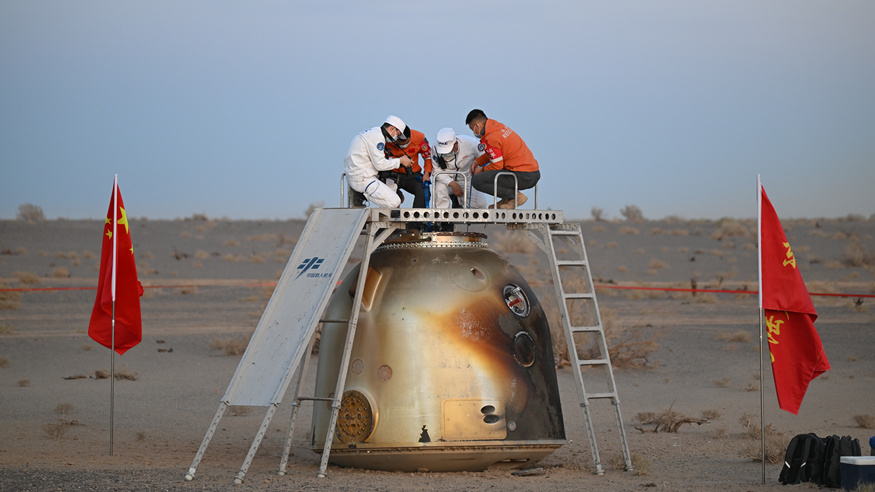
BEIJING, May 30 (Xinhua) -- A total of approximately 41.14 kg of scientific samples from China's space station, spanning 23 experimental projects in life sciences, materials and combustion, successfully returned to Earth aboard the Shenzhou-22 spacecraft on Friday, according to the Chinese Academy of Sciences (CAS).
It marks the tenth transfer of materials from China's orbiting laboratory.
Life science experiment samples, such as artificial embryos and brain organoids, were transported to the Technology and Engineering Center for Space Utilization (CSU) under the CAS in Beijing on Saturday.
After initial status checks, these specimens will be handed over to research teams for further study. The remaining samples will be transported to Beijing along with the Shenzhou-22 return capsule.
In the field of life sciences, scientists will focus on the cutting-edge area of "artificial embryos" to reveal how life adapts to space, providing vital health insights for future long-term space habitation and deep-space exploration.
For the returned samples, including novel titanium alloys, high-strength and tough steels, and relaxor ferroelectric single crystals, scientists will conduct rigorous analyses of their microstructures, chemical compositions, and compositional distributions to understand how gravity influences material growth, segregation, defects, and overall performance.
The findings will guide the optimization of new alloys and the ground-based production of key materials, supporting their application in aerospace, high-end manufacturing, precision sensing, and medical ultrasound imaging.
Following the return of combustion experiment samples -- including burners, soot collection plates, and collection lids -- scientists will analyze flame-synthesized semiconductor nanomaterials, soot samples, and the characteristics of carbon nanoparticle formation.
The findings are expected to provide technical support for extraterrestrial flame synthesis of nanomaterials, the development of new energy systems, space fire prevention technology, and the preparation of advanced functional carbon nanomaterials. ■









Comments